
Frequently Asked Questions: Inactivated Influenza Vaccine vs. Nasal Spray (FluMist®)
Should I get vaccinated early in 2026?(Click here for details)
Our clinic has been administering influenza vaccinations since September 11. In 2026, the flu season has started earlier than usual, entering the epidemic period even in Akita Prefecture. As of September 10, the number of patients is increasing, particularly in the southern part of the prefecture, and caution is required regarding the future spread of the infection.
We are receiving many questions asking, "It is still September, but should I get vaccinated early?"
We divide them into children who should get vaccinated promptly and children whose vaccination timing can be planned around important events such as exams or school entrance ceremonies.
🟠 Infants and toddlers / Children requiring 2 doses
In Japan, the influenza vaccine can be administered starting from 6 months of age. Children under 13 years old generally receive two doses.
The vaccination interval is 2 to 4 weeks, but to develop sufficient immunity, it is preferably administered about 4 weeks apart.
It takes time to complete up to the second dose, and it also takes about two weeks for immunity to develop after vaccination. Therefore, we recommend that children who need two doses get their first dose early, rather than waiting until the outbreak is in full swing.
🟠 Especially infants and toddlers should get vaccinated early.
Infants and young children are at an age where they are prone to neurological complications associated with influenza, such as convulsions, impaired consciousness, and encephalopathy or encephalitis.
Among them, children under 5, especially those under 2, are at a high risk of developing severe illness, so it is important to get vaccinated as soon as they become eligible.
🟠 1-dose for older kindergarteners / exam candidates
Since Akita Prefecture has already entered the influenza epidemic season, we generally recommend getting vaccinated early, even for older children who only need a single dose.
However, if there is a period from February onward when you particularly want to avoid infection—such as for entrance exams, graduation ceremonies, or school entrance ceremonies—you can also adjust the timing of vaccination while monitoring the infection situation in your region or school in order to easily maintain the vaccine's effectiveness during that period.
The effectiveness of the vaccine appears about two weeks after vaccination and then gradually decreases over time. If you delay vaccination, there is a possibility of getting infected by then, so we decide by considering both "timing it for important plans" and "protecting yourself from the current outbreak as early as possible."
🟠 If you have entrance exams or important events between December and January
For children aged 13 and older receiving a single dose, vaccination is recommended around October to November.
Because the epidemic is starting early this year, if the number of cases is increasing at schools or in the community, you might consider getting vaccinated during September.
🟠 If February and March are the most important periods
For children aged 13 and older receiving a single dose, vaccination around December is considered.
The effect appears about two weeks after vaccination, and March is about three months after vaccination, so it is thought that the effect can be easily maintained during this important period.
🟠 When placing special emphasis on entrance ceremonies and similar events from late March to April
For children aged 13 and older receiving a single dose, vaccination from December onward is recommended for consideration.
However, there is also the possibility of getting infected before vaccination.
If an outbreak spreads in your community or school, consider getting vaccinated early rather than waiting until the scheduled time.
🟠 Guide for when you are unsure
Infants and toddlers, especially those under 5 years old
Regardless of your event schedule, we recommend getting vaccinated early.
Children under 13 years old receiving two doses
Since it takes time until the second completion, let's take the first one early.
Children who have exams or important events between December and January
I am considering vaccination around October to November.
For children receiving a single dose, February and March are the most important months.
I am considering vaccination around December.
Children receiving a single dose, focusing on events like school entrance ceremonies from late March to April.
I will consider vaccination from December onwards.
🟠 The vaccination period varies for each individual.
The vaccination timing depends on age, the required number of doses, underlying medical conditions, the prevalence of outbreaks in nurseries or schools, and the dates of important events.
We recommend that infants, children with underlying medical conditions, and children requiring two doses get vaccinated early rather than delaying vaccination for events or school entrance exams.
If you are unsure, please consult with us during your visit.
While vaccination does not completely prevent infection, it is expected to be effective in reducing the risks of disease onset, hospitalization, and severe illness.
References
1. Grohskopf LA, et al. Prevention and Control of Seasonal Influenza With Vaccines: Recommendations of the Advisory Committee on Immunization Practices—United States, 2022–23 Influenza Season. MMWR Recomm Rep. 2022.
https://www.ncbi.nlm.nih.gov/pmc/articles/PMC9429824/
2.Committee on Infectious Diseases. Recommendations for Prevention and Control of Influenza in Children, 2025–2026: Technical Report. Pediatrics. 2025.
https://doi.org/10.1542/peds.2025-073622
3.Committee on Infectious Diseases. Recommendations for Prevention and Control of Influenza in Children, 2025–2026: Policy Statement. Pediatrics. 2025.
https://doi.org/10.1542/peds.2025-073620
4. Frankl S, et al. Influenza-Associated Neurologic Complications in Hospitalized Children. J Pediatr. 2021.
https://pubmed.ncbi.nlm.nih.gov/34293371/
5. Antoon JW, et al. Prevalence, Risk Factors, and Outcomes of Influenza-Associated Neurologic Complications in Children. J Pediatr. 2021.
https://pubmed.ncbi.nlm.nih.gov/34216629/
6.Fazal A, et al. Reports of Encephalopathy Among Children With Influenza-Associated Mortality—United States, 2010–11 Through 2024–25 Influenza Seasons. MMWR. 2025.
https://pubmed.ncbi.nlm.nih.gov/40014654/
7.Whitaker HJ, et al. Effectiveness of Influenza Vaccines and Duration of Protection Against Hospitalisation in England: 2022/2023 and 2023/2024 Seasons. Influenza Other Respir Viruses. 2025.
https://onlinelibrary.wiley.com/doi/10.1111/irv.70194
🌈 Influenzainactivated vaccineCare
Efficacy and Safety of the Influenza HA Vaccine in Children(Click here for details)
🟠 Number of Doses, Interval, and Timing
Recommended Doses
- Children aged 6 months or older but under 3 years: 0.25 mL × 2 doses (2–4 week interval)
- Children aged 3 years or older but under 13 years: 0.5 mL × 2 doses (2–4 week interval)
- Individuals aged 13 years or older: 0.5 mL × 1 dose
※Premature infants are also assessed based on chronological age. If the child turns 3 between doses, the first dose may be 0.25 mL and the second dose 0.5 mL
🟠 Safety
- The incidence rate of adverse reactions tends to increase with age (e.g., 13.58% in children aged 6 months to under 1 year; 49.69% in children aged 3 years to under 6 years)
- The main adverse reactions are swelling at the injection site and fever (fever occurs in 3.67% overall)
Severe side effects from the influenza vaccine are extremely rare. Not all cases reported as suspected side effects have been confirmed to be caused by the vaccine.
🟠 Actual efficacy rate (from case-control study)
・Children under 6 years of age: 33–571 TP3T for a single dose, 41–631 TP3T for two doses (significant for hepatitis B with two doses)
・Children under 3 years of age: 73–831 TP3T per dose (2018/2019–2019/2020)
・During the Type A (H1N1) outbreak: approximately 601 TP3T; during the Type A (H3N2) outbreak: approximately 401 TP3T; Type B: approximately 351 TP3T
・Summary for 2013/2014–2019/2020: Type A total: 441 TP3T; H1N1: 631 TP3T; Type B: 371 TP3T
・Infants aged 6 months to under 1 year: Significant efficacy observed during certain seasons (Type A 36%)
・Effect may be reduced in cases of underlying disease or immunosuppression.
Other points to note
The challenge of antigenicity changes due to egg adaptation is trending toward improvement.
High effectiveness when the prevalent strain and the vaccine strain match
Infants and young children are prone to severe illness, and vaccines are effective to some extent in preventing severe illness and death.
From the perspective of herd immunity, vaccination is also important.
Cannot be administered to infants under 6 months of age, but immunity is expected to be conferred to infants up to approximately 6 months of age after birth through vaccination of pregnant women.
Vaccination for children with febrile seizures
The Japan Society of Child Neurology states that "all current vaccinations can be administered without issue," but emphasizes the need for thorough explanations to parents and guidance on how to respond to fevers and seizures.
Literature
Bonhoeffer J, et al.: Arch Dis Child. 91(11): 929-935, 2006.
2) The European Agency for the Evaluation of Medicinal Products: Harmonisation of requirements for influenza vaccines. CPMP/BWP/214/96, March 1997. https://www.ema.europa.eu/en/documents/scientific-guideline/note-guidance-harmonisation-requirements-influenza-vaccines_en.pdf
3) Pharmaceuticals and Medical Devices Agency: Deliberation Results Report (August 2, 2011). https://www.pmda.go.jp/drugs/2011/P201100137/47003800_16100EZZ01207_A100_1.pdf
4) Grohskopf LA, et al.: MMWR Recomm Rep. 72(2): 1-25, 2023. https://www.cdc.gov/mmwr/volumes/72/rr/pdfs/rr7202a1-H.pdf
Denka Seiken Co., Ltd.: Influenza HA Vaccine "Seiken" Post-Marketing Surveillance Results Announcement. August 2013
6) Fukushima Wakaba, et al.: IASR. Vol. 40 pp.194-195: November 2019. https://www.niid.go.jp/niid/ja/typhi-m/iasr-reference/2471-related-articles/related-articles-477/9236-477r07.html
7) Shinjoh M, et al.: Vaccine. 37(30): 4047-4054, 2019.
8) Fukushima, Wakaba, et al.: IASR. Vol. 42 pp.255-257: November 2021 issue. https://www.niid.go.jp/niid/ja/typhi-m/iasr-reference/2545-related-articles/related-articles-501/10787-501r06.html
9) Shinjoh M, et al.: PLoS One. 10(8): e0136539, 2015.
10) Sugaya N, et al.: Euro Surveill. 21(42): 30377, 2016.
Sugaya N, et al.: Vaccine. 36(8): 1063-1071, 2018.
12) Shinjoh M, et al.: Vaccine. 36(37): 5510-5518, 2018.
Shinjoh M, et al.: PLoS One. 16(3): e0249005, 2021.
14) Shinjoh M, et al.: Vaccine. 40(22): 3018-3026, 2022.
Shinjoh M, et al.: Vaccine. 41(33): 4777-4781, 2023.
16) CDC: MMWR Recomm Rep. 62(RR-07): 1-43, 2013.
Kishida N, et al.: Clin Vaccine Immunol. 19(6): 897-908, 2012.
18) CDC: Preliminary Flu Vaccine Effectiveness (VE) Data for 2023-2024. https://www.cdc.gov/flu/vaccines-work/2023-2024.html
Maurel M, et al.: Euro Surveill. 29(8): 2400089. 2024.
20) National Institute of Infectious Diseases: Antigenic Analysis and Phylogenetic Tree of Circulating Influenza Virus Strains. https://www.niid.go.jp/niid/ja/flu-antigen-phylogeny.html
21) Ministry of Health, Labour and Welfare: Reiwa 5 (2023) Influenza Q&A. https://www.mhlw.go.jp/stf/seisakunitsuite/bunya/kenkou_iryou/kenkou/kekkaku-kansenshou/infulenza/QA2023.html
22) Flannery B, et al.: Pediatrics. 139(5): e20164244, 2017.
23) Takeda S, et al.: J Infect Chemother. 21(4): 238-246, 2015.
24) Expert Committee on Vaccination Guidelines, etc.: Vaccination Guidelines, 2024 Edition. Japan Vaccine Research Center. 2024.
25) Japanese Society of Child Neurology, Supervisor: Guidelines for the Management of Febrile Seizures (Febrile Convulsions) 2023. Diagnosis and Treatment Publishing Co.
🔄Influenza HA Vaccine: Dosage, Interval, and Recommended Timing
Recommended Number of Doses
- Individuals aged 13 to under 65 years, and those aged 65 years or older: typically receive one dose
- Individuals with significantly suppressed immune function may receive two doses at the physician’s discretion
Interval Between Two Doses
- Premature infants are vaccinated based on chronological age.
- Children under 13 years of age typically receive two doses spaced 2 to 4 weeks apart.
• - A 3 to 4 week interval is preferablefor effective immune acquisition
- The main adverse reactions are swelling at the injection site and fever; no serious adverse reactions have been reported.
- Infants and young children are at high risk of severe influenza, so vaccination is effective in preventing serious illness
- Infants under 6 months of age cannot be vaccinated.Vaccination during pregnancy is expected to confer immunity to the newborn.
- Children with febrile seizures can also be vaccinated.
Interval and Timing for Two-Dose Influenza HA Vaccination (Click to view)(Click here for details)
- According to the American Academy of Pediatrics (AAP),children receiving the influenza HA vaccine for the first timeare recommended to receive two doses,spaced at least 4 weeks apart.
Please note that a 4-day grace period is allowed, and vaccination as early as 25 days later (3 weeks + 4 days) is still considered valid.
• Japan’s Recommendations and Practical Approach
• In Japan,two doses of the influenza HA vaccine are recommended at an interval of 2 to 4 weeks.Administration 2 weeks after the first dose is widely practiced and accepted in clinical settings.
AAP isa minimum four-week interval to best enhance the immune responseis recommended. Leaving this interval allows the first dose to induce immunity and the second dose to maximize protection (i.e., fully exert the boost effect). As a result, antibody production and clinical preventive efficacy are further enhanced.
- Multiple clinical studies in Japan have shown that vaccination at 2- to 4-week intervals is effective, and there is no evidence of reduced efficacy when the second dose is given after 2 weeks.
- These recommendations are based on Japan-specific immunogenicity data and real-world effectiveness, supporting the validity of the 2-week interval in the Japanese context.
- Japan does not specify a strict “latest possible date” for vaccination.Instead, the primary goal is to complete vaccinationbefore the onset of the influenza season.
1. Recommendations for Prevention and Control of Influenza in Children, 2023–2024. Pediatrics. 2023;152(4):e2023063772. doi:10.1542/peds.2023-063772.
Recommendations for Prevention and Control of Influenza in Children, 2024-2025: Policy Statement. Pediatrics. 2024;154(4):e2024068507. doi:10.1542/peds.2024-068507.
Practice Guideline New Research
3. Effectiveness of Inactivated Influenza Vaccine in Children by Vaccine Dose, 2013-18. Shinjoh M, Sugaya N, Furuichi M, et al.
Vaccine. 2019;37(30):4047-4054. doi:10.1016/j.vaccine.2019.05.090.
4. Effectiveness of Influenza Vaccination Among Children in Satellite Cities of a Metropolitan Area in Tokyo, Japan During the 2014/2015-2018/2019 Season. Matsuda A, Asayama K, Obara T, Yagi N, Ohkubo T.
The Tohoku Journal of Experimental Medicine. 2022;258(1):69-78. doi:10.1620/tjem.2022.J057.
5. Influenza Vaccination in Japanese Children, 2024/25: Effectiveness of Inactivated Vaccine and Limited Use of Newly Introduced Live-Attenuated Vaccine. Shinjoh M, Tamura K, Yamaguchi Y, et al. Vaccine. 2025;61:127429. doi:10.1016/j.vaccine.2025.127429.
6. 2023–2024 Recommendations for Influenza Prevention and Control in Children
Pediatrics. 2023;152(4):e2023063772. doi:10.1542/peds.2023-063772.
7. Policy Statement on Influenza Prevention and Control in Children for 2024–2025
Pediatrics. 2024;154(4):e2024068507. doi:10.1542/peds.2024-068507.
8. Effectiveness of pediatric influenza vaccination by number of doses from 2013 to 2018
Shinjoh M, Sugaya N, Furuichi M, et al.
Vaccine. 2019;37(30):4047–4054. doi:10.1016/j.vaccine.2019.05.090.
9. Effectiveness of pediatric influenza vaccine in satellite cities near Tokyo (2014/15–2018/19)
Matsuda A, Asayama K, Obara T, et al.
Tohoku J Exp Med. 2022;258(1):69–78. doi:10.1620/tjem.2022.J057.
10. Effectiveness of the Influenza Vaccine in Japanese Children for the 2024/25 Season and the Limited Use of the Newly Introduced Live Vaccine
Shinjoh M, Tamura K, Yamaguchi Y, et al.
Vaccine. 2025;61:127429. doi:10.1016/j.vaccine.2025.127429.
Q:Vaccine Spacing and Co-administration
A: Since October 2020, there are no longer any required intervals between the influenza HA vaccine and other vaccines in Japan.
- As of July 2022, this also applies to the COVID-19 vaccine, making co-administration with the influenza vaccine possible.
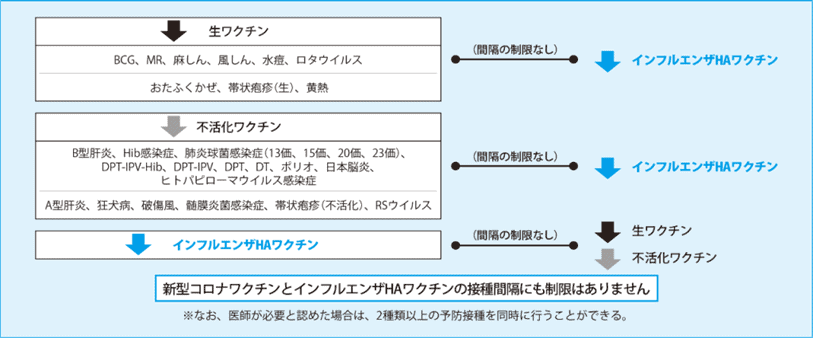
Literature(Click here for details)
1)Ministry of Health, Labour and Welfare: Notice regarding changes to regulations on vaccine administration intervals.
(Accessed as of March 29, 2024)
2)Ministry of Health, Labor and Welfare: COVID-19 Vaccine Q&A;.
(Accessed April 4, 2024)
Onset and Duration of Influenza Vaccine Effectiveness
🟠 Onset of Effectiveness
Immune protection begins approximately 2 weeks after vaccination, with antibody levels reaching protective thresholds around day 14.
🟠 Peak Effectiveness
The vaccine reaches its peak efficacy between 2 to 4 weeks post-vaccination.
🟠 Duration of Protection
The effectiveness of the vaccine appears about two weeks after vaccination and then gradually decreases over time. Generally, the duration of effectiveness is estimated to be around 5 to 6 months, but it does not suddenly disappear at a certain point, and the rate of decline varies depending on age and the circulating virus strain.
🟠 Strain-Specific Differences
The A(H3N2) subtype tends to wane more rapidly, with an estimated 7% monthly decline in effectiveness
🟠 Individual Variation
Immune response varies: about half of recipients show a modest antibody response, while others maintain strong and lasting immunity.
🟠 Recommended Timing
To ensure optimal protection, it is recommended to complete vaccination before the start of the influenza season, typically by late October.
This guidance is based on the latest recommendations from the American Academy of Pediatrics (AAP) and the Advisory Committee on Immunization Practices (ACIP).
Literature(Click here for details)
1. Recommendations for Prevention and Control of Influenza in Children, 2023-2024. Pediatrics. 2023;152(4):e2023063773. doi:10.1542/peds.2023-063773.
2. Prevention and Control of Seasonal Influenza With Vaccines: Recommendations of the Advisory Committee on Immunization Practices—United States, 2024–25 Influenza Season. Grohskopf LA, Ferdinands JM, Blanton LH, Broder KR, Loehr J.
MMWR. Recommendations and Reports: Morbidity and Mortality Weekly Report. Recommendations and Reports. 2024;73(5):1-25. doi:10.15585/mmwr.rr7305a1.
3. High-Resolution Antibody Dynamics Following Influenza Vaccination Reveal Predominantly Weak Responses as Well as Infrequent but Durable Immunity Across the 2014–2022 Seasons. Lane A, Quach HQ, Ovsyannikova IG, et al.
Vaccine. 2025;:127677. doi:10.1016/j.vaccine.2025.127677.
4. Intraseason Waning of Influenza Vaccine Protection: Evidence From the US Influenza Vaccine Effectiveness Network, 2011-12 Through 2014-15. Ferdinands JM, Fry AM, Reynolds S, et al.
Clinical Infectious Diseases: An Official Publication of the Infectious Diseases Society of America. 2017;64(5):544-550. doi:10.1093/cid/ciw816.
Q: Side Effects and Management After Influenza HA Vaccination
A: Common reactions include redness, swelling, or pain at the injection site. These usually resolve within 2–3 days.
- Occasional systemic symptoms may include fever, fatigue, headache, chills, rash, or hives.
- If the injection site becomes warm or swollen, apply a cool towel or compress to relieve discomfort.
A firm lump may remain temporarily, but it typically resolves over time.
- If you experience fever, monitor your condition and consider using cooling methods or antipyretics such as acetaminophen.
If you notice unusual symptoms, please consult a healthcare provider promptly.
When Vaccination Should Be Deferred
Vaccination is not recommended for individuals who:
- Have a fever of 37.5°C or higher
- Are suffering from a severe acute illness
- Have a history of anaphylaxis caused by previous vaccines
- Developed fever or widespread rash within 2 days of a routine vaccination (excluding voluntary vaccines)
Mild reactions such as redness, swelling, or low-grade fever do not necessarily prevent future vaccination.
Please consult your physician to determine whether vaccination is appropriate.
Tips to Reduce Pain and Anxiety During Vaccination
To help ease discomfort and anxiety during vaccination, the following strategies are recommended:
- Avoid using language that may increase fear or anxiety, especially with children or anxious individuals.
- If you have a history of fainting or feeling unwell during injections, consider receiving the vaccine while lying down.
・- Administering the vaccine deeply into the subcutaneous tissue at a 60–90° angle may help reduce local reactions such as swelling.
Intramuscular injections are generally associated with fewer local side effects than subcutaneous injections.。
Reporting Suspected Adverse Reactions (Click to view)(Click here for details)
・When adverse reactions are suspected following administration of the influenza HA vaccine, medical institutions report them in accordance with standards established by the national government. The reported data is evaluated by a specialized subcommittee of the Ministry of Health, Labor and Welfare and made public.
During the 2023–2024 season, out of approximately 54 million vaccinations, 57 cases were reported by medical institutions (including 34 severe cases and 5 deaths). Although these are extremely rare cases, appropriate measures are taken in the unlikely event that they occur.
If you have any concerns, please feel free to consult with a doctor or nurse before or after the vaccination. We ask for your understanding and cooperation to ensure a safe and secure vaccination process.
Literature(Click here for details)
1) Vaccination Guidelines Review Committee: Influenza and Pneumococcal Infection (Class B Disease) Vaccination Guidelines 2023 Edition. Vaccination Research Center. 2023.
2) Committee for the Review of Immunization Guidelines, et al.: Immunization Guidelines, 2024 Edition. Public Interest Incorporated Foundation Vaccination Research Center. 2024.
3) Japan Vaccine Industry Association (General Incorporated Association): Vaccine Basics 2023—From Vaccine Manufacturing to Distribution. 2023.
4) The Pharmaceutical Society of Japan: Glossary of Pharmaceutical Terms.
5) The 101st Meeting of the Subcommittee on Adverse Reactions of the Subcommittee on Immunization and Vaccines, Council for Health Science; and the 1st Meeting of the Safety Measures Investigation Committee of the Subcommittee on Safety Measures for Pharmaceuticals, etc., Pharmaceutical Affairs Subcommittee, Pharmaceutical Affairs and Food Sanitation Council, Reiwa 6 (Joint Session). Document 2-26. April 15, 2024. https://www.mhlw.go.jp/content/11120000/001244841.pdf(アクセス2024年4月16日現在)
6) National Institute of Infectious Diseases: App for entering “Reports of Suspected Adverse Reactions Following Vaccination.”. https://www.niid.go.jp/niid/ja/vaccine-j/6366-vaers-app.html(アクセス2024年3月29日現在)
7) Ministry of Health, Labour and Welfare, Health Science Council, Committee on Immunization and Vaccines, Subcommittee on Adverse Reactions. https://www.mhlw.go.jp/stf/shingi/shingi-kousei_284075.html(アクセス2024年3月29日現在)
8) Ministry of Health, Labour and Welfare: Request for reports from physicians, etc., based on the Immunization Act. https://www.mhlw.go.jp/bunya/kenkou/kekkaku-kansenshou20/hukuhannou_houkoku/(アクセス2024年3月29日現在)
Influenza and Tdap Vaccination During Pregnancy (Click to view)(Click here for details)
🟠Influenza Vaccine (Inactivated)
- The inactivated influenza vaccine is safe to administer at any stage of pregnancy.
- The Advisory Committee on Immunization Practices (ACIP)recommends vaccination during early, mid, or late pregnancy,as it plays a vital rolein preventing influenza-related complications in す。both the mother and the baby.
🟠 Tdap Vaccine (Tetanus, Diphtheria, Pertussis)
- The recommended timing for Tdap vaccination isbetween 27 and 36 weeks of pregnancy.
- Receiving the vaccine earlyin this window (around 27–30 weeks)allows for greater transfer of protective antibodies to the baby via the placenta, enhancing protection against pertussis (whooping cough) after birth.
- However, Tdap may be administered at any time during pregnancy if needed.
🟠 Why This Timing Matters
- These recommendations are based on scientific evidence showing that maximizing the maternal immune response and enhancing antibody transfer to the fetus provides passive immunity to the newborn.
- This is especially important during the early weeks after birth, when the baby is most vulnerable to infection but not yet eligible for direct vaccination.
References (partial list)
• Razzaghi H, et al. MMWR, 2020;69(39):1391-1397. doi:10.15585/mmwr.mm6939a2.
• Liang JL, et al. MMWR Recommendations and Reports, 2018;67(2):1-44. doi:10.15585/mmwr.rr6702a1.
• Healy CM, et al. JAMA, 2018;320(14):1464-1470. doi:10.1001/jama.2018.14298.
1) Vaccination Guidelines Review Committee: Influenza and Pneumococcal Infection (Class B Disease) Vaccination Guidelines 2023 Edition. Vaccination Research Center. 2023.
2) Committee for the Review of Immunization Guidelines, et al.: Immunization Guidelines, 2024 Edition. Public Interest Incorporated Foundation Vaccination Research Center. 2024.
3) Japan Vaccine Industry Association (General Incorporated Association): Vaccine Basics 2023—From Vaccine Manufacturing to Distribution. 2023.
4) The Pharmaceutical Society of Japan: Glossary of Pharmaceutical Terms.
5)The 101st Meeting of the Subcommittee on Adverse Reactions of the Subcommittee on Immunization and Vaccines of the Council for Health Science, and the First Meeting of the Safety Measures Investigation Committee of the Subcommittee on Safety Measures for Pharmaceuticals, etc., of the Pharmaceutical Affairs Subcommittee of the Pharmaceutical Affairs and Food Sanitation Council for Reiwa 6 (Joint Session). Document 2-26. April 15, 2024. (As of April 16, 2024)
6)National Institute of Infectious Diseases: "Post-Vaccination Adverse Event Suspected Report" Input App. (Accessed as of March 29, 2024)
7)Ministry of Health, Labour and Welfare: Request for reporting by doctors, etc., based on the Immunization Act. Accessed as of March 29, 2024
8)Subcommittee on Adverse Reactions, Health Science Council Committee on Immunization and Vaccines. Accessed on March 29, 2024
Influenza HA Vaccination for Individuals with Allergies
🟠 Individuals with egg allergy or bronchial asthma are generally eligible for vaccination.
🟠 The influenza HA vaccine contains only trace amounts of egg-derived components (typically a few nanograms per milliliter).Therefore, it is considered safe for most people with egg allergy or asthma,and adverse reactions are extremely rare.between 27 and 36 weeks of pregnancy.
Domestic and US Responses (from Vaccination Guidelines)(Click here for details)
• Contraindications for vaccination:
Those with a history of anaphylaxis due to vaccine ingredients
• Persons requiring caution with vaccination:
Those with allergies to chicken-derived ingredients such as eggs and chicken meat
Allergic diseases such as asthmaPoor controlIn case of
• Points to note during vaccination:
Get in good physical condition before vaccination and check your allergy history during the medical questionnaire.
It is recommended to observe patients inside the clinic for 30 minutes after vaccination and to establish an emergency response system.
• Vaccination for asthma patients:
To prevent asthma exacerbations caused by infections,Influenza vaccination is useful.it is considered that,Can often be administered even during steroid treatment(Please consult your doctor for details)
US Response (from ACIP recommendations)
• Influenza vaccination is recommended regardless of the presence or absence of an egg allergy.is being done
• No additional safety measures are necessaryIt is considered that it can be handled in the same way as routine vaccination.
After vaccination15-minute observationis recommended (to reduce risks such as fainting)
Literature
1) Vaccination Guidelines and Other Research Committee: Vaccination Guidelines 2024 Edition. Vaccination Research Center. 2024.
2)Greenhawt M, et al.: Ann Allergy Asthma Immunol. 120(1): 49-52, 2018.
3) Nagao M, et al.: J Allergy Clin Immunol. 137(3): 861-867, 2016.
4) "Asthma Prevention and Management Guideline 2021" Compilation Committee: Asthma Prevention and Management Guideline 2021. Supervised by the Japanese Society of Allergology, Asthma Guideline Professional Committee. Kyowa Kikaku; 2021.
CDC: MMWR Recomm Rep. 60 (RR-2): 1-60, 2011.
6)Vasileiou E, et al. : Clin Infect Dis. 65(8): 1388-1395, 2017.
7) GINA: Global Strategy for Asthma Management and Prevention. 2020.
8) Committee on Infectious Diseases: Recommendations for Prevention and Control of Influenza in Children, 2019-2020. Pediatrics. 144(4): e20192478, 2019.
Influenza HA vaccination for pregnant women, nursing mothers, and those planning to become pregnant
Significance and benefits of vaccination
• Pregnant women are more likely to develop severe illness if they contract influenza, there are concerns about the strain on cardiorespiratory function and the effects on the fetus.
• Inactivated influenza HA vaccine is highly safe throughout all stages of pregnancy, vaccination is recommended worldwide.
• When pregnant women receive the vaccination,the effect of antibodies transferring to the fetus via the placenta, protecting infants up to 6 months of ageis expected.
• By vaccination of a nursing mother,Preventing maternal infection leads to preventing transmission to the infant.It is considered.
Can be vaccinated even during fertility treatmentand it is considered to have no effect on the fetus after pregnancy is established.
Recommended vaccination schedule
• What are the effects of the vaccine?Lasts from about 2 weeks to about 5 months after vaccinationI will.
• The influenza epidemic in Japancentered around January to MarchBecause ofVaccination is ideal between October and mid-December.between 27 and 36 weeks of pregnancy.
Safety and Precautions
• Symptoms such as fever, swelling, and fatigue as side effects occur with the same frequency regardless of pregnancy.
• There are no reports of increased risks such as miscarriage, premature birth, or malformations.
• Even if a nursing mother receives the vaccination, it will not adversely affect the infant through breast milk.
Even if an infant has an egg allergy, vaccination of the breastfeeding mother is generally not a problem.
• If the mother herself has an egg allergy and avoids consuming eggs, the feasibility of vaccination must be carefully determined.
About preservatives (thimerosal)
• Some vaccines contain trace amounts of thimerosal (ethylmercury) as a preservative, but it is not believed to have any effect on the fetus, and any link to autism has been ruled out.
• For vaccination of pregnant women, it is recommended to choose preservative-free formulations if possible.
Regarding the timing of influenza HA vaccine administration, its effectiveness, and precautions after contracting viral diseases such as shingles or mumps: also, what to do if family members or people around you contract them.
Guidelines for the timing of inactivated influenza vaccination after recovering from a viral disease
• In mild cases
→ Can be vaccinated as soon as symptoms have resolved
• In moderate cases
Wait about two weeks after recovery
• Diseases that cause immunosuppression (e.g., measles)
→ Guideline is 4 weeks or more after healing
• In the case of shingles
Can be vaccinated if the acute phase has passed and the condition is showing a tendency toward recovery.
What to do if a family member or someone around you becomes infected
• Prior explanation is important to avoid misunderstandings about complications, especially aseptic meningitis after mumps or thrombocytopenic purpura after rubella.
• Determine based on the type of disease and the current outbreak situation
• Vaccination during the incubation period should be administered with caution, as it can easily be mistaken for an adverse reaction
Influenza Vaccination After Recovering from Infection
General Recommendations (Japan)
- Vaccination remains effective even after a prior influenza infection.
- It is recommended to wait 1 to 2 weeks after full recovery before receiving the vaccine.
- During the influenza season, early vaccination after recovery is encouraged to maintain protection.
- Since influenza viruses include multiple subtypes, reinfection with a different strain is possible even after one episode.
🟠 U.S. CDC Guidance
- The Centers for Disease Control and Prevention (CDC) reports that vaccination during the recovery phase or incubation period does not reduce vaccine effectiveness or increase the risk of side effects.
- Vaccination is not contraindicated for individuals with mild acute illness, those recovering, or those receiving antibiotics.
- Even during hospitalization, patients with mild to moderate illness are generally eligible for vaccination.
- The Centers for Disease Control and Prevention (CDC) reports that vaccination during the recovery phase or incubation period does not reduce vaccine effectiveness or increase the risk of side effects
- Vaccination is not contraindicated for individuals with mild acute illness, those recovering, or those receiving antibiotics.
- Even during hospitalization, patients with mild to moderate illness are generally eligible for vaccination.
Literature(Click here for details)
1) Vaccination Guidelines and Other Research Committee: Vaccination Guidelines 2024 Edition. Vaccination Research Center. 2024.
2)CDC: Contraindications and Precautions. General Best Practice Guidelines for Immunization. (Accessed April 12, 2024)
3)Health, Labour and Welfare Bureau for COVID-19 Control, Ministry of Health, Labour and Welfare: Administrative Notice. Regarding the approach to isolation periods after the change in the legal classification of COVID-19 under the Infectious Diseases Control Act (Prior information regarding handling from May 8, 2023). April 14, 2023. Accessed as of March 29, 2024
Q: Please tell me what points to keep in mind when administering the influenza HA vaccine to individuals with underlying conditions such as respiratory, cardiovascular, or renal diseases, and diabetes, or during the perioperative period.(Click here for details)
A: 1 Individuals with underlying medical conditions are strongly recommended to get vaccinated, as they are prone to severe illness if they contract influenza.
2. Except for those for whom vaccination is contraindicated, it is generally safe to receive, but caution is required in differentiating between side effects and the effects of underlying medical conditions or treatments.
3. In patients with chronic respiratory diseases, serious side effects are rare, but post-vaccination observation is necessary given the risks of asthma attacks and interstitial pneumonia.
4 Patients with cardiovascular disease should be careful of blood pressure fluctuations and vasovagal reactions due to injection site pain, and those taking anticoagulants should also consider bleeding at the injection site.
5. There are also reports that influenza vaccination reduces the risk of cardiovascular events.
6. Active vaccination is recommended for patients with kidney disease, especially dialysis patients, because they have a high risk of infection and mortality rate.
7. Patients with liver disease can receive the vaccination if their condition is stable, and caution should be exercised regarding injection site bleeding if thrombocytopenia is present.
8. Although immune responses are slightly reduced in patients with autoimmune diseases and those in an immunosuppressed state, safety has been reported.
9. Care must be taken to differentiate vaccine side effects in patients with cerebrovascular disorders or central nervous system diseases. For epilepsy patients, vaccination should be administered when their condition is stable, and it is important to explain seizure prevention measures.
10 Although slightly less effective in diabetic patients, it is effective, contributes to reducing the risk of hospitalization and death, and annual vaccination is recommended.
Perioperative vaccination is generally avoided because it makes symptom differentiation difficult, but it is considered on an individual basis, and for organ transplant patients, the timing of vaccination is determined according to their condition.
12. After recovering from COVID-19 symptoms and becoming non-infectious, vaccination is possible, and simultaneous vaccination is not a problem.
Vaccination outside of medical facilities is possible at home or elsewhere as long as safety management is in place, and careful medical interviews and observation are important for immunocompromised patients.
Based on these factors, under appropriate management, influenza HA vaccination for patients with underlying medical conditions is an important infection prevention measure.
Literature(Click here for details)
1)Ministry of Health, Labour and Welfare: FY2023 Influenza Q&A. (Accessed April 9, 2024)
2)CDC: Who Should and Who Should NOT get a Flu Vaccine. Accessed April 9, 2024
3)The 101st Meeting of the Subcommittee on Adverse Reactions of the Subcommittee on Immunization and Vaccines of the Council for Health Science, and the First Meeting of the Safety Measures Investigation Committee of the Subcommittee on Safety Measures for Pharmaceuticals, etc., of the Pharmaceutical Affairs Subcommittee of the Pharmaceutical Affairs and Food Sanitation Council for Reiwa 6 (Joint Session). Document 2-26. April 15, 2024. (As of April 16, 2024)
4) Pesek R, et al.: Allergy. 66(1): 25-31, 2011.
5) Udell JA, et al.: JAMA. 310(16): 1711-1720, 2013.
6) Japanese Society of Nephrology: Evidence-based clinical practice guideline for CKD 2023. June 2023.
7) Japanese Association of Dialysis Physicians: Guidelines for Standard Dialysis Operations and Infection Prevention in Dialysis Facilities (6th Revised Edition). December 2023.
8) Song JY, et al.: J Clin Virol. 39(3): 159-163, 2007.
9) Huang Y, et al.: Curr Med Res Opin. 33(10): 1901-1908, 2017.
10) Westra J, et al.: Nat Rev Rheumatol. 11(3): 135-145, 2015.
11) Lu CC, et al.: Vaccine. 29(3): 444-450, 2011.
12) Japanese Society for AIDS Research: Vaccination Guidelines for People Living with HIV. July 2023.
13) Japanese Society for Pediatric Infectious Diseases, supervisor: Guidelines for Vaccination in Immunocompromised Patients 2024. 2024.
14) Vaccination Guidelines Review Committee: Vaccination Guidelines 2024 Edition. Vaccination Research Center; 2024.
15) Casper C, et al.: Blood. 115(7): 1331-1342, 2010.
16) Lau D, et al.: Thorax. 68(7): 658–663, 2013.
17) Vamos EP, et al.: CMAJ. 188 (14): E342-E351, 2016.
18) Japan Diabetes Society, ed.: Treatment Guide for Diabetes 2019. Nankodo, 2019.
19) Nobuhiko Okabe, Keiko Taya, Hajime Kamiya: Q&A on Vaccinations 2023. Q9 p.46-47, Japan Vaccine Industry Association. 2023.
20) Japanese Society for Hematopoietic and Immune Cell Therapy: Guidelines for Hematopoietic Cell Transplantation: Vaccination (4th Edition). December 2023.
21) Tartof SY, et al.: Ann Intern Med. 164(9): 593-599, 2016.
22)Japan Respiratory Society (General Incorporated Association) COVID-19 FAQ Hub. (Accessed April 9, 2024)
23) Japan Pediatric Society, Japan Society for Pediatric Infectious Diseases, and Japan Association for Ambulatory Pediatrics, Pediatric COVID-19 Joint Working Group: Guidelines for the Clinical Management of Coronavirus Disease 2019 (COVID-19) in Pediatric Outpatient Practice, 2nd ed. September 29, 2021.
24)Ministry of Health, Labor and Welfare: COVID-19 Vaccine Q&A;. (Accessed April 9, 2024)
25)Ministry of Health, Labour and Welfare: Guidelines for Routine Vaccination Implementation.
26) Ministry of Health, Labour and Welfare Notification: Isei-hatsu No. 0331 No. 68, Ken-hatsu No. 0331 No. 28. March 31, 2015.
27)Caldera F, et al.: Vaccine. 39: A15-A23, 2021.
Q:What is the effectiveness of influenza vaccination in healthy adults under the age of 65? (Click to view)(Click here for details)
A: On the Efficacy of the Influenza HA Vaccine
• The influenza HA vaccine has been shown to have a relatively high preventive effect for healthy adults under 65 years of age, and vaccination is recommended.
• If the vaccine strain and the circulating strain match,Approximately 60% effectiveness in preventing the onset of the diseaseis expected.
• This is particularly important for caregivers of individuals at high risk of severe illness and for healthcare workers.
• However, because influenza viruses mutate every year, their effectiveness decreases if the antigenicity of the vaccine strain and the circulating strain do not match.
Still, vaccination can often reduce the risk of severe illness and hospitalization,Annual vaccination is recommended for everyone aged 6 months and older who is eligible.It is being done.
Reference 1)Ministry of Health, Labour and Welfare FY2023 Influenza Q&AAccessed April 4, 2024
2)Demicheli V, et al.: Cochrane Database Syst Rev. 2(2):1-255, 2018
3) CDC: Who needs a flu vaccine (Retrieved April 4, 2024)
4)CDC: CDC seasonal flu vaccine effectiveness studies (Retrieved April 4, 2024)
5)Ministry of Health, Labour and Welfare Infectious Disease Control Manual for Elderly Care Facilities Revised Edition 2019 (Retrieved April 4, 2024)
6) Children and Families Agency, Nursery School Infectious Disease Control Guidelines 2018 (Retrieved April 4, 2024)
7)Baumgartner EA, et al.: J Infect Dis.206(6):838-846,2012 8)Vaccination Guidelines and Other Issues Review Committee, Influenza and Pneumococcal Vaccination Guidelines, 2023 Edition, 2023
9)CDC: Guidance for Cruise Ships on Influenza-like Illness (ILI) Management
10) WHO: Influenza surveillance outputs (Accessed: May 13, 2024)
11)National Institute of Infectious Diseases Influenza Patient Incidence Status (Retrieved May 13, 2024)
12)Japan National Tourism Organization JNTO Annual Number of Foreign Visitors to Japan(Accessed May 13, 2024)
13)Japan Vaccine Society 2022-23 Season Statement on Seasonal Influenza Vaccination (Retrieved April 4, 2024)
🧬About the Influenza Nasal Live Vaccine FluMist®
Eligibility and contraindications for FluMist® (live attenuated influenza vaccine: LAIV)
The target age is 2 years old and over and under 19 years old (ages 2 to 18), and the vaccination is given once.
Those who cannot be vaccinated
- Those under 2 years old or 19 and older
- Individuals with obvious fever or severe acute illness
- Those who have had anaphylaxis to any component of FluMist®
- Individuals with clear immunodeficiency or those undergoing immunosuppressive treatments
- Pregnant women
Please be sure to inform us before vaccination.
- I have asthma or am currently wheezing
- Severe nasal congestion
- I have had a severe allergic reaction to eggs or gelatin.
- History of convulsions or Guillain-Barré syndrome
- I have underlying medical conditions such as heart, lung, kidney, liver, or blood disorders.
- I use salicylic acid drugs such as aspirin.
- Recently used Tamiflu, Relenza, Inavir, Rapiacta, Xofluza, etc.
- Living with or in close contact with individuals with severe immunodeficiency
In the United States, children aged 2 to 4 years with a history of wheezing or asthma within the past 12 months are not eligible to receive FluMist®. In Japan, vaccination is not uniformly contraindicated, but our clinic will determine eligibility after reviewing symptoms and treatment status.
Vaccines secured after booking cannot be returned, so if you are unsure whether you can receive the vaccination, please consult a doctor before booking.
About allergies
FluMist® hasPurified gelatinis included, and in the manufacturing processfertile chicken eggis used.
Having an egg allergy alone does not mean you cannot receive the vaccination, but anyone who has ever experienced anaphylaxis from eggs or gelatin must inform us in advance.
Precautions after vaccination
After vaccination, especially for about a week, the influenza rapid test may be positive due to the vaccine-derived virus. Symptoms such as a runny or stuffy nose, cough, sore throat, headache, fever, and fatigue may occur.
When visiting a medical institution due to a fever or other symptoms, please inform them of the date you received FluMist®.
For 1 to 2 weeks after vaccination, please avoid close contact with severely immunocompromised individuals as much as possible.
Literature(Click here for details)
References
FDA. FluMist Prescribing Information.
PMDA. FluMist Quadrivalent Nasal Suspension Package Insert. Revised August 2026 (6th edition)
PMDA: FluMist Quadrivalent Nasal Spray Patient Medication Guide
Grohskopf LA, et al. Prevention and Control of Seasonal Influenza with Vaccines: Recommendations of the Advisory Committee on Immunization Practices. MMWR.
American Academy of Pediatrics. Recommendations for Prevention and Control of Influenza in Children, 2024–2025. Pediatrics. 2024;154(4).
Turner PJ, et al. Safety of Live Attenuated Influenza Vaccine in Young People With Egg Allergy: Multicentre Prospective Cohort Study.
Turner PJ, et al. Safety of Live Attenuated Influenza Vaccine in Atopic Children With Egg Allergy. J Allergy Clin Immunol. 2015;136(2):376–381.
Greenhawt M, Turner PJ, Kelso JM. Administration of Influenza Vaccines to Egg Allergic Recipients: A Practice Parameter Update 2017. Ann Allergy Asthma Immunol. 2018;120(1):49–52.
Ali T, et al. Detection of Influenza Antigen With Rapid Antibody-Based Tests After Intranasal Influenza Vaccination (FluMist). Clin Infect Dis. 2004;38(5):760–762.