Food Allergy and Oral Food Challenge
📢🍳Food allergiesは
🌸Types and symptoms of food allergies
Patients with food allergies have many things to manage, such as checking food ingredient labels, using substitute foods, and submitting documents to daycare centers and schools. Not eating certain foods due to pickiness is completely different from not being able to eat them due to life-threatening allergic reactions.
• There are various types of food allergies. The first type is when symptoms appear within 2 hours of consuming the causative food.Immediate food allergyIt can be seen in various parts of the body, such as hives, itching, diarrhea, vomiting, coughing, and hoarseness. It is an allergic reaction that can cause severe symptoms in multiple organs and can be life-threatening.Anaphylaxisand further, when accompanied by low blood pressure and impaired consciousness, it is called anaphylactic shock.
• Skin symptoms such as hives and itching are seen in 90% of people, but severe and dangerous symptoms include hoarseness, wheezing, and repeated vomiting. If these symptoms appear within approximately two hours after consuming food, call an ambulance immediately.Epinephrine auto-injector (EpiPen®)Because it is effective when used early, please do not hesitate to use it if it is prescribed.
The second is,Pollen-food allergy syndromeThis occurs in people with IgE antibodies against pollen. It is seen in patients with hay fever, and when they eat fruits or vegetables, they develop symptoms such as itching, mainly in the mouth and ears, because their bodies recognize proteins similar to those in pollen as new allergens.
•The third isFood-dependent exercise-induced anaphylaxisAlthough rare, allergic reactions and sometimes anaphylaxis occur after eating a trigger food and then exercising.
Food allergens
The foods that cause food allergies vary from person to person. In infancy, chicken eggs, dairy products, and wheat are common. In early childhood, fish roe and nuts become more common, and from school age onward, fruits, shrimp, and crab (crustaceans) are more frequently the cause. According to the results of a nationwide survey by the Consumer Affairs Agency in 2020, nuts ranked third as a causative food for the first time since the survey began in 2005, following eggs and milk (External link: Report on Research Project Related to Food Labeling for Food Allergies, Fiscal Year 2021).

Sensitization and onset in food allergies
Our bodies have a function called "immunity" that protects us from pathogens such as harmful bacteria and viruses. "Allergies" are when this "A condition in which the immune system overreacts to foods that should normally be harmless.This refers to (see figure below, external link).(Quoted from the 2021 Revised Edition of the Easy-to-Understand Food Allergy Guidebook for Asthma Prevention)
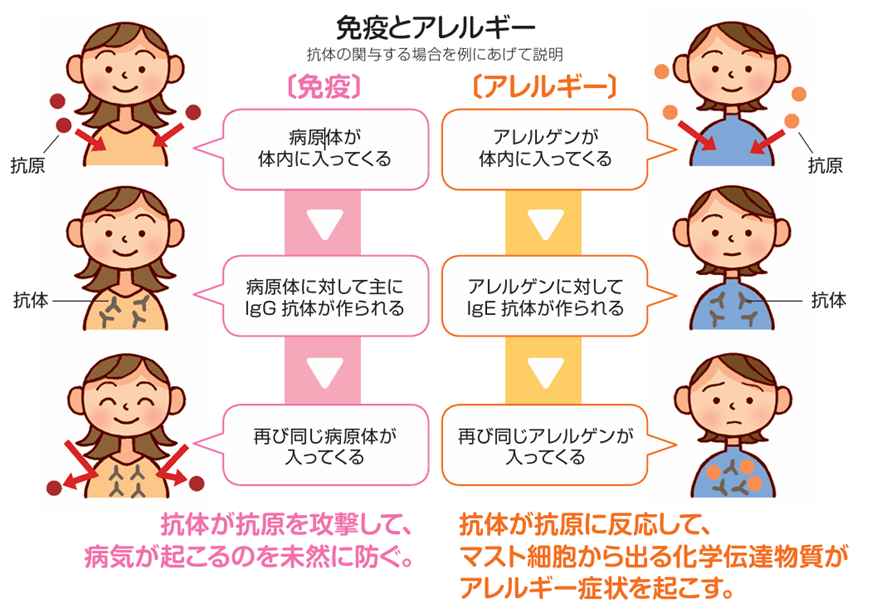
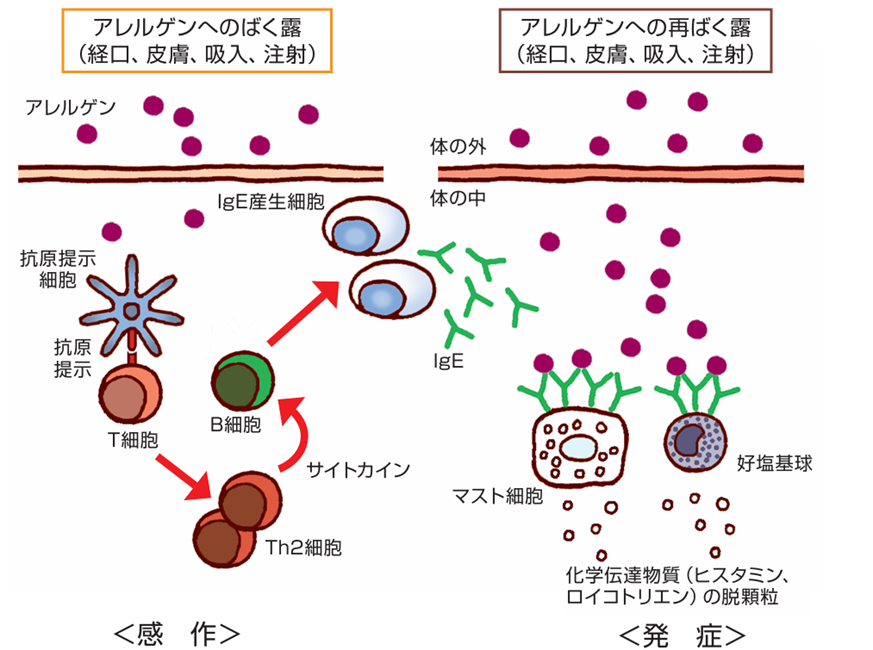
It has become understood that when IgE antibodies are produced against food, the cause is not food that has been eaten, digested, and absorbed, but rather allergens or food that has entered the body through the skin, such as eczema. IgE antibodies attach to the surface of cells called mast cells, which are present on the skin and mucous membranes throughout the body. This state is called sensitization, but an allergic reaction does not occur simply from sensitization. When, for example, milk enters the body again as an allergen and reacts with IgE antibodies, histamine and other substances are released from mast cells and other cells, causing allergic symptoms.(See diagram below) [External link] Easy-to-understand food allergy guide for asthma prevention 2021 Revised Edition(Quoted from)
🥛Food allergy progression
It depends on the causative food, but food allergies that appear at a young age tend to resolve naturally with age. Food allergies that appear in school-aged children or adults are less likely to resolve naturally.
If a food allergy is suspected, our clinic will conduct tests to identify the food that causes the allergy. The most important step is the consultation, where we will confirm what was eaten, the quantity, and the time elapsed between eating and the onset of symptoms. However, please note that if symptoms such as hives or diarrhea appear after food intake, it is not necessarily due to a food allergy. If specific foods suspected of causing a food allergy are identified, we will perform tests such as blood tests and skin tests.
🧪About the Oral Food Challenge
Our hospital is a certified facility for pediatric food allergy challenge tests.
To minimize necessary dietary restrictions and enable patients to eat foods as early as possible, we conduct food oral challenge tests in addition to dietary guidance. This test involves eating small amounts of food repeatedly over several hours to observe for any symptoms.
The basic treatment for food allergies is to eliminate the causative food. However, the approach to food elimination has significantly changed in the last 10 years, shifting from "eliminate anything that is suspected" to "eliminate the minimum necessary." We now eliminate only foods that truly cause symptoms and encourage individuals to eat causative foods within a "tolerable range."
In our country, about 10% of infants, about 5% of toddlers, and about 1.5-3% of children after school age have food allergies. Food allergies to chicken eggs, dairy products, and wheat in infancy and early childhood are naturally overcome by 50% of children by age 3 and 80-90% by age 6.
Accurate diagnosis of the causative food is necessary to treat food allergies. Oral food challenge tests greatly contribute to this. This is a test conducted at medical institutions where the suspected food is eaten once to several times over several hours to see if symptoms appear.
The purpose of testing is to determine the causative food, to judge whether foods that have been eliminated for a certain period can be eaten, and to re-evaluate for admission to daycare or school whether the food is truly inedible, what quantity can be consumed, and whether severe symptoms will occur. Even with food allergies, it may be possible to determine the amount of food that can be ingested and incorporate it into one's diet.
The important thing is that even if a blood test or skin test is positive, it is not a food allergy if you eat it and do not develop symptoms. In some cases, the involvement of food in atopic dermatitis that developed in infancy may be overlooked, and the skin symptoms do not improve. However, in other cases, food elimination from infancy may continue without re-evaluation.
Here's the flow for conducting an oral food challenge test: First, based on age, medical history (what symptoms occurred, when, and under what circumstances), and allergy test results, we'll consult on whether there's an indication for performing a food challenge test. We'll consider factors such as age and symptom severity. For induced symptoms, depending on their severity, we'll promptly administer treatments such as oral or intravenous antihistamines, inhaled bronchodilators, or intramuscular adrenaline injections.
Starting April 2022, children under 16 years old can undergo oral food challenges up to three times a year under their health insurance.
• Please feel free to consult us if you have any of the following concerns.
My baby's eczema is severe, and I'm worried about food allergies.
I want to know if it's really impossible to eat for enrollment/admission.
I want to know how much I can eat.
If eating causes symptoms, I want emergency medication.
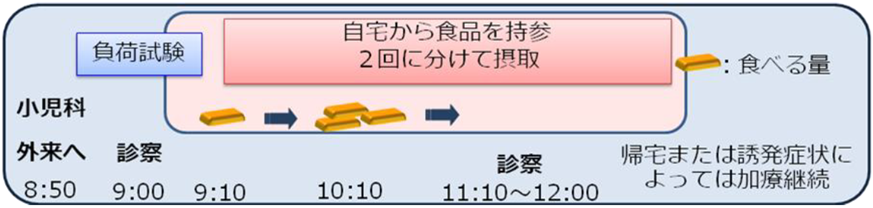
🕒Flow of the Day for Oral Food Challenge
• Around 9 AM, consume the food brought from home, then increase the amount to determine if it can be eaten.
I can return home after 11:30 AM. (It might take until the evening.)
For more details, please refer to the brochure at the reception.
Please consult with your doctor during your visit to our department regarding load tests.
Chicken eggs are the most common food allergen in infants and young children.
When performing a provocation test at our hospital, we use egg powder.Our hospital has been involved as a cooperating facility from the clinical trial stage (external link)We have safely completed examinations with many children before.
The advantages of using chicken egg powder include that parents do not have to prepare load test meals, and children who are put off by the appearance of whole eggs can more easily consume it.
There is no cost to your family.
Easy-to-Understand Food Allergy Response Guidebook for Asthma Prevention 2021 Revised Edition