Treatment for atopic dermatitis
🫧 Treatment for Atopic Dermatitis
The three pillars of atopic dermatitis treatment are① Pharmacotherapy
② Skincare
③ Management of exacerbating factorsbetween 27 and 36 weeks of pregnancy.
Not only through medication (applying ointment, injections, oral medication), but also by sharing information with parents about skincare tailored to the child's growth, we aim to eliminate acute inflammation first.
• In atopic dermatitis, inflammation may remain in the skin that appears normal after the inflammation has subsided. Proactive therapy is performed when there is a recurring condition where rashes worsen immediately after stopping ointment application, even after improving. This is a treatment method where, once the skin becomes smooth with no itching, redness, or dryness due to sufficient application of steroid ointment, the application of anti-inflammatory drugs or immunosuppressants (steroids, tacrolimus, delgocitinib, difamilast ointment) is used at a reduced frequency, such as twice a week, to maintain the state where inflammation is suppressed.
• The amount of topical medication to be used, the area to be covered, and the duration of application will be determined on an individual basis. In childhood, management of common comorbidities such as food allergies and asthma will also be performed concurrently. Daily skincare, including the use of moisturizing topical medications, is necessary even during proactive therapy. (Refer to the figure below)Atopic Dermatitis Management Guidelines 2021 (Quoted from the Atopic Dermatitis Management Guidelines Steering Committee, The Japanese Dermatological Association and The Japanese Society of Allergology)
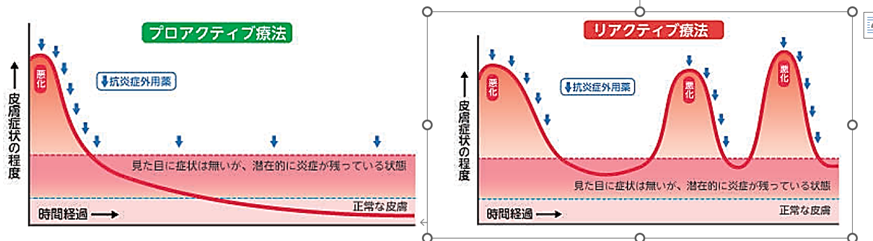
• On the other hand, patients who experience exacerbations only a few times a year, such as in winter or summer, will continue with skincare and moisturizers only, and will undergo reactive therapy, applying ointment when symptoms such as itching appear.
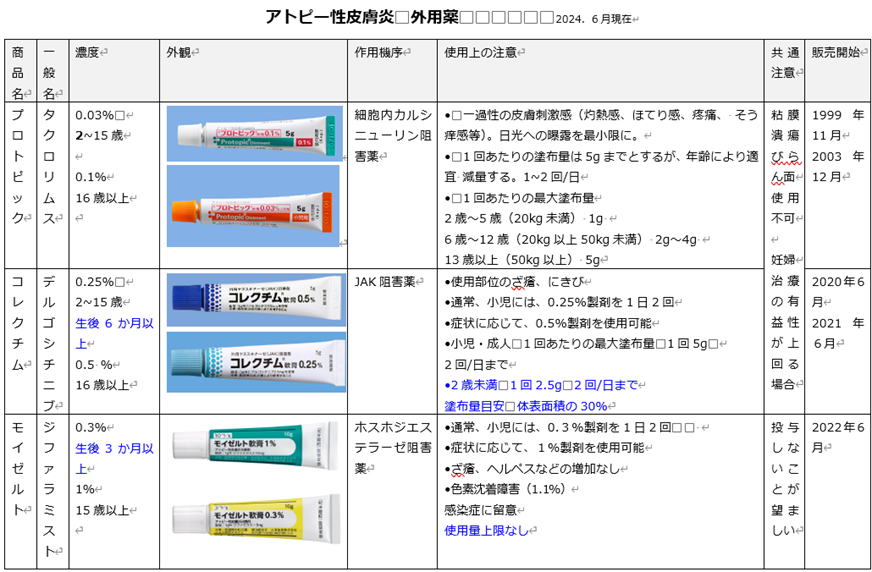
• The following three types of topical medications are used in proactive therapy after sufficient use of topical steroids to alleviate itching and skin inflammation.
• For those who have difficulty controlling itching even after thorough treatment as described above.
The understanding of atopic dermatitis has made remarkable progress, and with it, new drugs with novel mechanisms of action have become available to dramatically alleviate itching.
①Dupixent® (external link)Subcutaneous injection medication Dupixent | About Dupixent | For Patients Using Dupixent | Sanofi K.K.
Dupixent® is a new type of medication that suppresses the skin's type 2 inflammatory response (inflammation caused by Th2 cells) by directly blocking the action of substances called cytokines* called "IL-4" and "IL-13." By suppressing the inflammatory response occurring within the skin in atopic dermatitis, it improves symptoms such as itching and skin conditions like rashes.
Those who can administer
As of September 2023, it has become available for children aged 6 months and older in Japan.
Individuals who cannot be administered
Individuals with a history of allergic reactions to the ingredients in Dupixent®
• Patients requiring caution during administration
• Individuals with parasitic infections
Those planning to receive a live vaccine
Pregnant women, women who may be pregnant, or nursing mothers.
Elderly people
• Those with other allergic diseases such as asthma
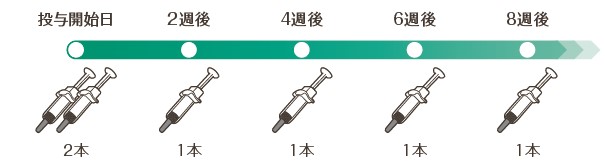
The administration schedule varies by age and weight, as follows. At our hospital, the initial dose and the second dose are administered on-site as per the established administration method. For patients who wish to self-inject from the third dose onwards, we switch to self-injection as soon as possible and provide long-term prescriptions for up to three months.
Regarding possible side effects and their symptoms
Allergic reaction
Injection site reaction
Herpes infection
Conjunctivitis
About Dupixent® Drug Costs and Medical Expense Subsidy Programs (External Link)
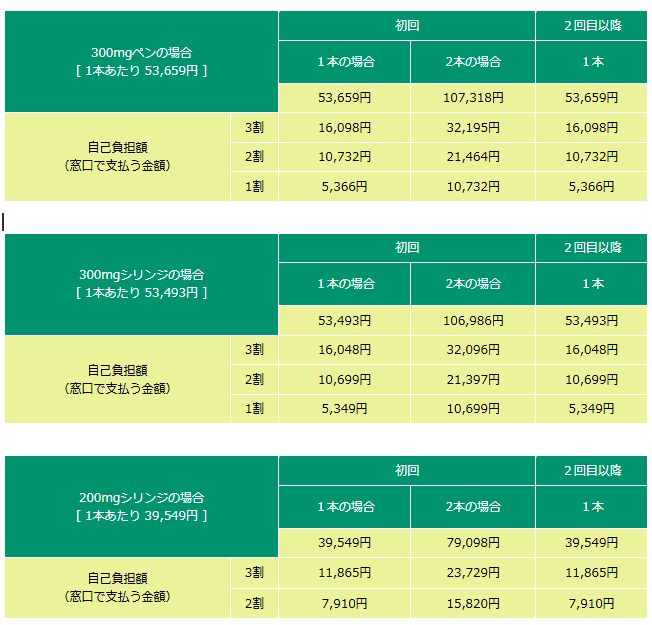
This calculation is based on the drug price of Dupixent® as of November 2024.
As of April 2025, for infants under 1 year old residing in Akita City, there is no out-of-pocket expense.
Children in households subject to resident tax income tax (aged 1 year and over) have a co-payment of up to 1,000 yen per month per medical institution (including pharmacies), separated by inpatient and outpatient care (external link: Akita City - Child Welfare Medical System).For all individuals under 18, the co-payment at the counter is capped at 1,000 yen.
20%: Ages 6-69, and those 70 and over with high income comparable to active workers.
10%: Ages 70-74 with general or low income.
10%: Ages 75 and over with general or low income. (From October 1, 2022, some individuals will have a 20% co-payment.)
💷High-cost Medical Expense Benefit System
How the High-Cost Medical Expense Benefit System works
This is a system that limits the amount you pay at the medical institution's counter (your out-of-pocket cost) to a certain amount (out-of-pocket maximum) if it exceeds a certain threshold within a month (from the 1st to the last day of that month). For more details, please check with your insurer.
Please also refer to the following materials.
To Patients Using Dupixent® (External Link)
Dupixent Patient Medication Guide (external link)
Patient to Drug Guide
🟣② Rinvoq (External link)Oral medicine
For patients taking Rinvoq® for atopic dermatitis | [Atopic Dermatitis] AbbVie Official Site | Rinvoq.jp
Rinvoq® binds to a part called "JAK" inside immune cells, preventing the overproduction of inflammatory cytokines that cause itching. By suppressing inflammation inside the skin, it is expected to improve the inflammation and itching that appear on the skin's surface.
Those who can receive the treatment: Individuals with moderate to severe atopic dermatitis whose symptoms do not improve with topical corticosteroid treatment. It is also indicated for children aged 12 and over who weigh 30 kg or more.
Those who cannot be administered
Patients with a history of hypersensitivity to the components of this drug
• Those with severe infectious diseases (such as sepsis)
• Active tuberculosis patient
Patients with severe hepatic dysfunction
Those with a neutrophil count below 1000/mm³
Individuals with a lymphocyte count below 500/mm³
People with hemoglobin levels below 8 g/dL
Pregnant women or those who may be pregnant
Pre-administration check
Have you ever had an allergic reaction to any of the ingredients in Rinvoq® in the past?
• Not infected with infectious diseases/tuberculosis/hepatitis B virus
• Risk of venous thromboembolism
Presence or absence of diverticula
Experience with interstitial pneumonia
• Check for abnormalities in blood tests
• No liver or kidney damage
Experience with malignant tumors
• Pregnant or possibly pregnant
• Whether breastfeeding
• Vaccination schedule
Regular blood tests and chest X-rays are necessary, not just before introduction.
Dosage instructions: Take once daily. No restrictions on time of day.
Symptoms to watch out for while taking medication (external link) Precautions during administration | Atopic Dermatitis AbbVie Official Website | Rinvoq®.jp
Please consult a doctor if you experience the following symptoms.
Acne is a common condition. Please consult your doctor as there are treatments available.
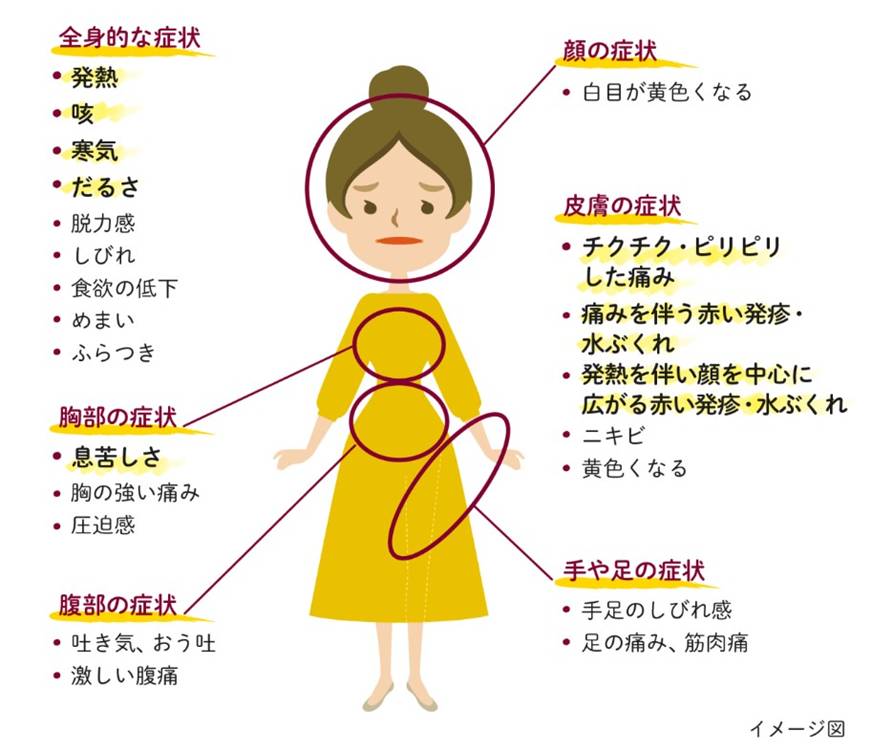
Estimate of drug costs
Click here for a simulation of the medical insurance system/medical expenses (external link).
Please also check the following materials.
To adolescent patients (ages 12-17) with atopic dermatitis taking Rinvoq® and their families (external link))
Atopic Dermatitis Management Guidelines 2024 (Japan Dermatological Association)The Japanese Society of Allergology (Atopic Dermatitis Clinical Practice Guidelines Steering Committee) (External link)